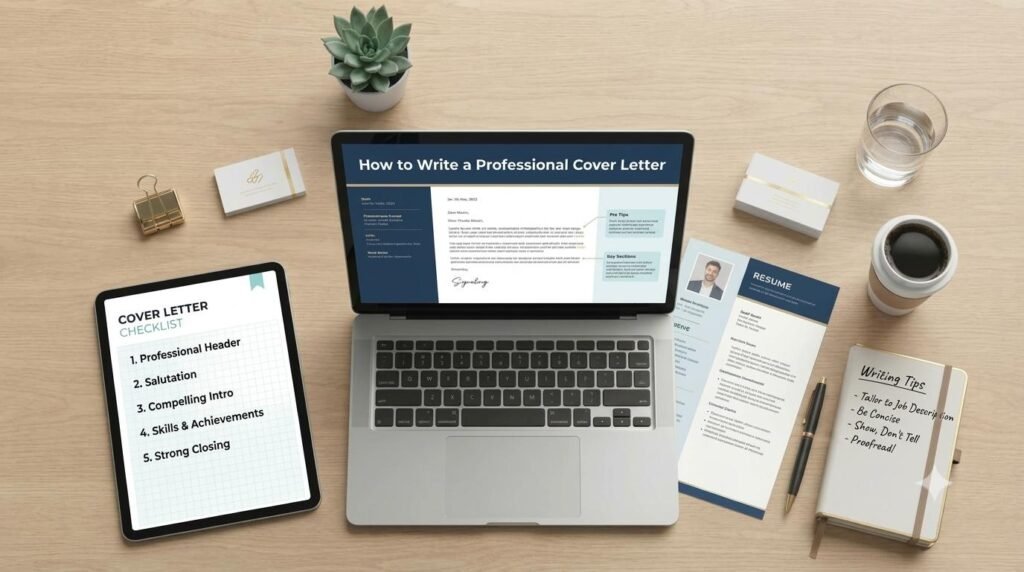
A well-written cover letter can help you make a strong first impression when applying for a job. Learning how to write a professional cover letter is important because it allows you to introduce yourself, explain your interest in a position, and show an employer why your skills and experience make you a suitable candidate. Whether you are a fresher, an experienced professional, or someone changing careers, a clear and personalized cover letter can strengthen your job application.
In this guide, you will learn how to structure a cover letter, what information to include, how to avoid common mistakes, and how to create a professional letter for different job opportunities.
Understanding how to write a professional cover letter can help you present your qualifications and make your job application more effective.
Table of Contents
ToggleWhat Is a Professional Cover Letter?
A professional cover letter is a short document submitted along with your resume when applying for a job. It introduces you to the employer and explains why you are interested in the position.
While a resume focuses on your qualifications, employment history, education, and skills, a cover letter allows you to explain how those details relate to the specific job.
A good cover letter should:
Introduce you and mention the position you are applying for.
Explain why you are interested in the company and role.
Highlight relevant skills, experience, and achievements.
Show how you could contribute to the organization.
Encourage the employer to review your resume and consider you for an interview.
A clear understanding of how to write a professional cover letter helps you introduce your qualifications in a structured and relevant way.
Why Is a Cover Letter Important for a Job Application?
A resume may provide an overview of your professional background, but it does not always explain your motivation or suitability for a particular position. A cover letter helps connect your qualifications with the employer’s requirements.
Here are some reasons why a cover letter can be valuable:
1. Creates a Professional First Impression
A well-organized letter shows that you have taken time to prepare your application. Clear writing, correct details, and a professional tone can help create a positive impression.
When learning how to write a professional cover letter, always begin with accurate contact information.
2. Highlights Your Most Relevant Skills
You can use your cover letter to draw attention to the skills and achievements that are particularly relevant to the job instead of repeating your entire resume.
3. Explains Your Interest in the Position
Employers may want to understand why you are interested in their organization. A cover letter gives you space to communicate your motivation and career goals.
4. Provides Context for Your Career Background
If you are a fresher, changing careers, returning to work, or applying after a career break, you can use the letter to explain your situation positively and professionally.
5. Shows Your Communication Skills
A clear and thoughtfully written cover letter can demonstrate your ability to communicate information in a structured and professional way.
Knowing how to write a professional cover letter helps you communicate your strengths and demonstrate your suitability for a specific position.
How to Write a Professional Cover Letter Step by Step
A professional cover letter does not need to be complicated. The key is to organize your information logically and focus on what the employer needs to know.
Follow these steps when preparing your letter.
Step 1: Add Your Contact Information
Start with your basic contact details so the employer can identify you and contact you if required.
Include:
Your full name
Email address
Phone number
City or location
Date of application
Use a professional email address and check that your contact information is accurate.
Step 2: Address the Hiring Manager
Whenever possible, address your letter to the hiring manager or recruiter by name.
For example:
Dear Ms. Sharma,
If you cannot find the person’s name, you can use a suitable professional greeting such as:
Dear Hiring Manager,
Avoid overly casual greetings in a formal job application.
Step 3: Write a Strong Opening Paragraph
The opening paragraph should clearly state the position you are applying for and briefly introduce your professional background.
For example:
“I am writing to express my interest in the Digital Marketing Executive position at ABC Solutions. With practical knowledge of content marketing, social media management, and SEO, I am eager to contribute my skills to your marketing team.”
Keep your introduction specific to the position rather than using a generic opening for every application.
One of the most important parts of how to write a professional cover letter is creating an opening that captures the employer’s attention.
Step 4: Highlight Your Relevant Skills and Experience
The main paragraph should explain why you are a suitable candidate.
Choose two or three relevant skills, experiences, or achievements that match the job description.
For example, if you are applying for a customer support position, you might highlight:
Strong verbal and written communication.
Experience handling customer queries.
Ability to resolve problems professionally.
Familiarity with customer relationship management tools.
Where possible, support your claims with a real example or measurable achievement. Avoid listing skills without explaining how you have used them.
Knowing how to write a professional cover letter also means selecting skills and achievements that match the requirements of the job.
Step 5: Explain Why You Want to Join the Company
Show that you understand the position and have a genuine reason for applying.
You can mention the company’s work, products, services, values, or professional opportunities that interest you. Keep this section relevant and avoid exaggerated compliments.
A personalized explanation is more useful than sending exactly the same letter to every employer.
Step 6: Write a Professional Closing Paragraph
End your letter by briefly reinforcing your interest in the position and thanking the employer for considering your application.
For example:
“Thank you for considering my application. I would welcome the opportunity to discuss how my skills and experience could contribute to your team. I look forward to hearing from you.”
Use a professional closing such as:
Sincerely,
Your Full Name
Professional Cover Letter Format
A consistent format makes your application easier to read. A standard professional cover letter generally includes the following sections:
Your Contact Details: Name, email, phone number, and location.
Date: The date you are submitting the application.
Employer Details: Hiring manager’s name, company name, and location, when available.
Greeting: A professional salutation.
Opening Paragraph: The position you are applying for and a short introduction.
Main Paragraph: Relevant skills, qualifications, experience, and achievements.
Closing Paragraph: Your interest in the opportunity and a polite request for consideration.
Sign-off: A professional closing followed by your name.
Keep the formatting simple, with readable fonts, clear paragraphs, and consistent spacing.
A well-organized structure makes it easier to understand how to write a professional cover letter for different job opportunities.
Professional Cover Letter Example
Here is a basic example you can use as a reference. Replace the sample details with your own information and customize the content for the job.
Rahul Verma
rahul.verma@example.com
+91 98765 43210
New Delhi, India
Date: 17 November 2026
Hiring Manager
ABC Solutions
New Delhi, India
Subject: Application for the Digital Marketing Executive Position
Dear Hiring Manager,
I am writing to express my interest in the Digital Marketing Executive position at ABC Solutions. I have developed knowledge of digital marketing, content creation, social media management, and search engine optimization, and I am interested in applying these skills in a professional environment.
Through my learning and practical work, I have developed an understanding of keyword research, website content optimization, and social media marketing. I enjoy exploring digital marketing strategies and finding ways to improve online visibility and audience engagement. I am also comfortable learning new tools and adapting to changing project requirements.
I am particularly interested in joining ABC Solutions because the opportunity aligns with my professional interests and offers the chance to contribute to meaningful marketing projects. I believe my willingness to learn, attention to detail, and commitment to quality would help me contribute positively to your team.
Thank you for considering my application. I would appreciate the opportunity to discuss my qualifications and suitability for this position in an interview.
Sincerely,
Rahul Verma
Note: This is an illustrative example. Replace the sample name, contact details, company information, and skills with accurate personal details before submitting an application.
How to Write a Cover Letter as a Fresher
If you are applying for your first job, you may not have formal work experience. However, you can still prepare a strong cover letter by focusing on your education, relevant skills, projects, internships, and willingness to learn.
Consider including:
Your educational qualification.
Relevant academic projects.
Internships or volunteer experience, if available.
Technical and communication skills.
Certifications or training related to the position.
Your interest in the industry and the role.
For example, a fresher applying for a software development position can mention programming languages, academic projects, coding practice, and relevant coursework.
Be honest about your experience. Do not present academic projects or personal learning as professional employment.
Freshers can also learn how to write a professional cover letter by highlighting their education, projects, and transferable skills.
How to Write a Cover Letter With No Experience
Having no professional experience does not mean you have nothing valuable to offer.
Focus on transferable skills and activities that demonstrate your ability to perform the job.
You can highlight:
Academic projects and practical assignments.
Communication and teamwork.
Problem-solving and organizational skills.
Online courses and certifications.
Volunteer activities.
Personal projects relevant to the position.
Explain what you learned from these experiences and how those skills relate to the job you want.
Cover Letter Tips for Experienced Professionals
Experienced candidates should use their cover letters to demonstrate the value they can bring to a new organization.
Follow these practical tips:
Highlight experience that directly matches the job description.
Mention important achievements instead of repeating your entire employment history.
Use measurable results when they are accurate and relevant.
Explain why you are interested in the new role.
Keep the letter focused on the employer’s needs.
Avoid unnecessary technical details that do not support your application.
For example, instead of simply saying that you managed a sales team, mention the team size, responsibilities, or verified results that demonstrate your contribution.
Experienced candidates should understand how to write a professional cover letter that demonstrates their achievements and professional value.
Common Cover Letter Mistakes to Avoid
Even a well-qualified applicant can weaken an application through avoidable writing mistakes.
Watch out for these common problems:
1. Sending the Same Letter to Every Employer
A generic letter may not show why you are interested in a specific position. Customize the opening and relevant skills for each application.
2. Repeating Your Entire Resume
Your cover letter should complement your resume, not reproduce it. Select the most relevant information and explain its value.
3. Making the Letter Too Long
A cover letter should be concise and easy to scan. In most cases, one page is sufficient.
4. Using an Unprofessional Tone
Avoid slang, casual expressions, and exaggerated claims. Use confident, respectful, and clear language.
5. Ignoring Spelling and Grammar
Proofread your letter before submitting it. Check the employer’s name, job title, company name, and your contact details carefully.
6. Forgetting to Customize the Job Title
Make sure the position mentioned in your letter matches the job you are applying for.
7. Making Unsupported Claims
Do not invent achievements, qualifications, or work experience. Every statement should accurately represent your background.
Following the right approach to how to write a professional cover letter can help you avoid these common mistakes.
How to Create a Professional Cover Letter Online
If you are unsure how to organize your information, an online cover letter tool can make the process easier.
You can use our free Cover Letter Generator to prepare a structured job application letter using your own details.
Follow these simple steps:
Open the Cover Letter Generator.
Enter your name, email address, phone number, and location.
Add the hiring manager’s name and company details when available.
Select your experience level.
Enter your relevant skills, achievements, education, and motivation.
Choose a suitable writing tone.
Generate and review your cover letter.
Copy the letter, download it as a text file, or use the print option to save it as a PDF.
The generator uses the information you enter to prepare a structured letter. Review the result carefully and make any changes needed before sending it to an employer.
These steps make it easier to understand how to write a professional cover letter and prepare a more organized job application.
Cover Letter vs Resume: What Is the Difference?
A cover letter and a resume serve different purposes in a job application. Both documents can work together to present your qualifications effectively.
| Cover Letter | Resume |
|---|---|
| Introduces you to the employer. | Summarizes your professional background. |
| Explains your interest in a particular job. | Lists education, experience, and skills. |
| Highlights selected qualifications. | Provides a structured career overview. |
| Usually written in paragraphs. | Usually uses headings and bullet points. |
| Customized for the specific opportunity. | Updated to match relevant job requirements. |
If you are preparing both documents, you can also use our One-Page Resume Builder to create a clean and professional resume.
Frequently Asked Questions
A professional cover letter is generally one page long. Keep it concise and focus on the qualifications and experience most relevant to the position.
Follow the employer’s application instructions. If a cover letter is requested or there is an opportunity to include one, a customized letter can help explain your suitability for the role.
Yes. Freshers can highlight education, academic projects, internships, certifications, volunteer activities, and transferable skills relevant to the position.
Mention the job title, briefly introduce yourself, and explain your interest in the opportunity. Keep the opening direct and specific.
It is better to customize your cover letter for each application. Adjust the job title, company details, relevant skills, and reasons for applying.
Yes. An online generator can help organize your details into a structured letter. Always review and personalize the result before submitting it.
A resume and cover letter serve different purposes. A resume summarizes your background, while a cover letter explains why your qualifications are relevant to a particular opportunity. Follow the employer’s instructions when applying.
Final Thoughts
Writing a professional cover letter is an important part of preparing a strong job application. The most effective letters are clear, relevant, honest, and tailored to the position. Focus on your strongest qualifications, explain your interest in the opportunity, and show how your skills can contribute to the organization.
Before submitting your application, proofread your letter and check that all personal and company details are correct. If you need help organizing your information, try our free Cover Letter Generator and prepare a professional starting draft for your next job application.
Related Guides Cards
One-Page Resume / CV Builder
Create a clean, professional one-page resume with your experience, skills, and education.
Free Cover Letter Generator
Prepare a structured job application letter using your personal details, skills, and experience.
Explore More Free Tools & Utilities
Discover a collection of free calculators, productivity tools, and useful online utilities designed to make your everyday tasks easier.
Explore More Digital Tools at DigiMarket
Looking for more useful digital resources and productivity solutions? Explore DigiMarket – The Marketplace for Digital Treasures to discover digital products, practical resources, and tools designed to support your online work and learning.
Whether you are exploring digital resources for business, marketing, or productivity, DigiMarket offers a growing collection of useful digital solutions.
Learn More with Prernaa
Want to improve your digital skills and learn practical ways to work smarter? Explore Prernaa – Inspiring Learning for useful learning resources, practical guides, and educational content.
Discover helpful information that can support your personal learning and digital growth.